
How to distinguish between real and fake crystals? What is the significance of real crystals?
Crystal, with its translucent texture, rich colors, and culturally significant beautiful meaning, has become a popular category in the jewelry market. However, with the surge in demand, glass imitations, synthetic crystals, and natural crystals are intermingled, and many consumers are deceived due to a lack of identification knowledge. This article will dissect the core characteristics of natural crystals and share six easy-to-operate identification methods to help you avoid purchasing traps and accurately identify the “true face” of natural crystals.
1. Appearance details: The “imperfection” code of natural crystal
The formation process of natural crystals, which has undergone billions of years of geological processes, inevitably leaves natural imprints. On the other hand, imitations are often too “perfect”, which provides the most intuitive breakthrough for identification.
Inclusion differences: Natural crystals often contain tiny gas-liquid inclusions, needle-like minerals, cloudy cotton-like substances, or ice cracks, which are irregularly distributed and serve as natural “proof of identity”; glass imitations are usually pure and empty inside, or only contain bubbles (mostly round or oval, evenly distributed); the inclusions in synthetic crystals may exhibit regular needle-like or filamentous arrangements, lacking natural randomness.
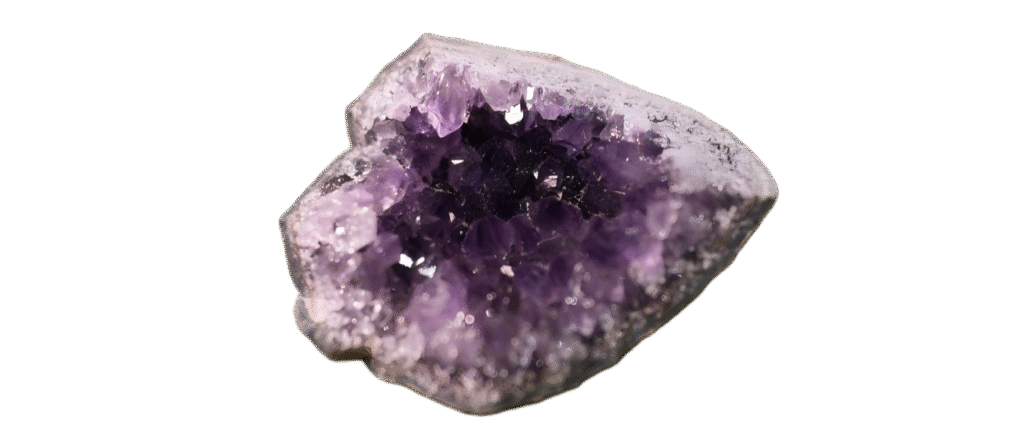
Color distribution: Natural crystals often exhibit gradual color transitions, which may include color bands and clusters. For example, amethysts may have varying shades of purple, while citrines may have uneven hues. On the other hand, dyed glass or synthetic crystals tend to have overly bright and uniform colors, with unnatural color bands, and even traces of color accumulation at cracks.
Surface texture: The surface of natural crystal is soft and moist, with a glassy or oily luster, and feels cool and smooth to the touch; the luster of glass imitations is harsh, and they feel warm to the touch, with edges that may have slight burrs or polishing marks, lacking the fineness of natural crystal.
II. Physical properties: verifying the essence with “scientific methods”
The physical properties of crystal (hardness, density, optical effect) are difficult for imitations to replicate, and can be preliminarily detected with simple tools
Hardness test: Natural crystal has a Mohs hardness of 7, second only to diamond and corundum. It can be lightly scratched on the surface of glass (be careful with the force to avoid damaging the crystal). If a clear scratch can be left and the crystal itself is not damaged, it is highly likely to be natural crystal. Glass has a hardness of only 5-6 and cannot scratch glass, but may be scratched by glass instead. Note: This method is only applicable to unmounted crystals to avoid damaging valuable jewelry
Density comparison: The density of natural crystal is approximately 2.65g/cm³, which is slightly higher than that of glass (approximately 2.5g/cm³). You can compare a crystal with an equivalent volume of glass in clear water, and the natural crystal will feel “heavier”; or weigh them with your hand, and a crystal of the same size will feel more pressing than glass. This method should be used in conjunction with other characteristics to avoid misjudgment based on a single criterion
Optical effect: Natural crystals exhibit birefringence. When placed on a newspaper and observing the text through the crystal, a double image of the text appears. Glass, on the other hand, is a uniaxial crystal, and the observed text does not have a double image. Additionally, natural crystals have a higher refractive index, which gives them a soft and lustrous appearance when rotated, while glass has a relatively dull luster, even giving a sense of “dead light”
III. Professional Testing: Avoiding Traps with Authoritative Certification
If you have doubts about the authenticity of a crystal, especially a high-priced one, it is recommended to seek testing through professional channels and obtain authoritative certification
Certificate inquiry: Natural crystals sold by legitimate merchants should come with a jewelry appraisal certificate (such as NGTC, GIA, etc.). The certificate will clearly indicate “natural crystal”, “synthetic crystal”, or “glass”, and include key parameters such as weight, size, and refractive index. The authenticity of the certificate can be verified through the QR code on the certificate or by checking on the official website
Laboratory testing: If there is no certificate, the crystal can be sent to a professional jewelry testing laboratory for testing using instruments such as infrared spectroscopy and Raman spectroscopy to accurately determine the naturalness of the crystal and whether it has been dyed or optimized. Laboratory testing results have a high accuracy rate and are a reliable way to identify high-priced crystals
IV. Guide to Avoiding Pitfalls: These Misconceptions to Avoid
Misconception 1: “The more transparent, the more natural.” Natural crystals may contain inclusions. A crystal that is too pure and free of impurities may actually be synthetic crystal or glass
Misconception 2: “The brighter the color, the more precious it is.” Natural crystals often have soft and natural colors. Colors that are too bright and uniform may be the result of dyeing treatment, and the color of dyed crystals will gradually fade over time
Misconception 3: “Buying good crystal at a low price”. The formation cost of natural crystal is high, especially for high-quality natural crystals (such as pure amethyst and citrine), so the price will not be too low. If you encounter a “natural crystal” with a price far below the market price, be wary of whether it is an imitation
Conclusion: Rationally discern and enjoy the beauty of crystal
To distinguish between real and fake crystals, one needs to make a comprehensive judgment based on various aspects such as appearance, physical characteristics, and professional certification. It requires both practical identification skills and a rational consumer mindset. Mastering the above methods can not only avoid purchasing traps but also enable one to gain a deeper understanding of the natural beauty of natural crystals. Whether for collection or wearing, the value of natural crystals lies not only in their material itself but also in their unique charm formed over hundreds of millions of years. I hope you can find your own natural crystal treasure through scientific identification